

Applied AI
AI Systems
We build AI systems, not demos. From retrieval-grounded assistants and autonomous agents to ML-powered product features, we engineer applied AI with the evaluation, observability, and human-in-the-loop controls it takes to trust it in production — and we operate it once it's live.
Engineered to production standard · fully owned
The problem
Most “AI” ships as a demo that impresses in a meeting and breaks in production — ungrounded, unevaluated, and impossible to trust with real decisions.

Our approach
We build AI as a system: grounded in your data, wrapped in guardrails and evals, observable in production, and operated long after launch.
Not a demo. A system that runs.
Every part is engineered to production standard — measured, monitored, and owned.
- TargetProduction uptime
- 99.9%
- TargetManual work removed
- −60%
- TargetMedian inference
- 40ms
- TargetFaster decisions
- 3×
Figures are targets we engineer to on a typical engagement — not averaged client results.
From raw data to production
- Ingest
- Train
- Evaluate
- Deploy
- Monitor
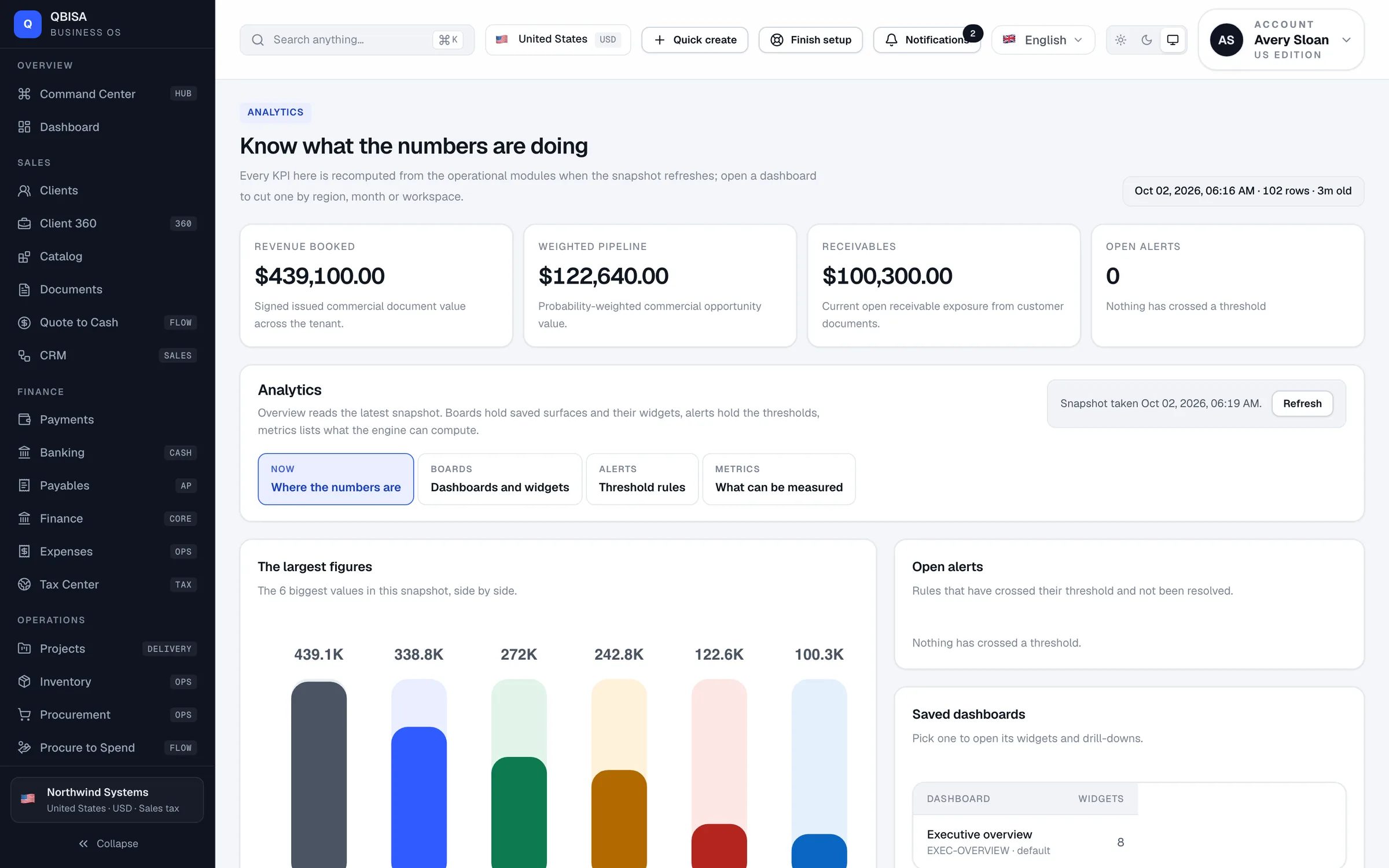
Our own product
QBISA
A next-generation ERP for companies of up to 10,000 employees
Read the case studyWho this is for
SaaS teams shipping AI features
Ship in-product AI your customers actually trust — grounded, evaluated, and monitored, not a demo bolted onto the roadmap.
Ops-heavy businesses
Deflect repetitive support and back-office volume with a copilot that knows your data, freeing the team for the work that needs a human.
Regulated & enterprise teams
Get the audit trails, guardrails, and human-in-the-loop controls that let AI touch real decisions without risking compliance.
Where teams put it to work

Support copilot
Deflect repetitive tickets with an assistant grounded in your docs and history.
Internal agent
Automate multi-step back-office workflows with tool-using agents.
In-product AI
Ship AI features — summarize, generate, classify — inside your product.

Why this, why now
Every category is being rebuilt around AI. Ship it well, or watch a competitor do it first.
The gap isn't between companies that use AI and companies that don't — it's between systems that are grounded, evaluated, and trusted, and demos that impress once and get quietly shelved.
Typical timelines
Ballpark, for a focused first version — not a guarantee, a starting point for scoping.
- Support copilot grounded in your docs4–6 weeks
- Retrieval-grounded internal assistant6–8 weeks
- ML-powered in-product feature6–10 weeks
- Autonomous / multi-step agent8–12 weeks
- Full AI platform, multiple features12–16+ weeks
How we build AI Systems

Ground
Connect your data with retrieval, so answers are based on truth — not the model's imagination.
Constrain
Guardrails, tool-use boundaries, and human-in-the-loop for the decisions that matter.
Evaluate
Automated eval suites and tracing, so quality is measured every release — not guessed.
Operate
Monitoring, cost controls, and feedback loops once it's live in front of users.
What we ship
- Retrieval-grounded assistants & copilots
- Autonomous & semi-autonomous agents
- ML-backed product features
- Eval, tracing & observability pipeline
- Guardrails & human-in-the-loop controls
- Provider-agnostic architecture
Typical stack
- Python
- TypeScript
- Anthropic
- Google Gemini
- LangChain
- Hugging Face
- PostgreSQL
- Docker

Questions, answered
No. Your data stays yours. We use retrieval and private deployments, and never train shared models on it without explicit agreement.
We stay provider-agnostic — OpenAI, Anthropic, open models — and architect so you can switch without a rewrite.
Grounding in your data, strict tool boundaries, evals that catch regressions, and human review on high-stakes actions.

Tell us about your AI Systems project
Let's turn it into something that earns its place in production.

A specialist reads every message personally — usually within one business day.

Have an AI problem worth solving?
Book a strategy call. We'll discuss your goals, the architecture, and how we'd build it.