

Workflow automation
Automation
We design automation as infrastructure: data pipelines, integrations, and intelligent workflows that quietly remove manual effort and reduce error. The result is leverage — your team scales output without scaling headcount.
Engineered to production standard · fully owned
The problem
Teams scale by hiring people to do repetitive, error-prone work by hand — until the manual glue becomes the bottleneck.

Our approach
We build automation as infrastructure: pipelines and intelligent workflows that remove manual effort and run unattended.
The busywork, gone.
Workflows that connect your tools and run around the clock — reliable, observable, auditable.
- TargetManual work
- −60%
- TargetThroughput
- 5×
- TargetAlways on
- 24/7
- TargetAuditable
- 100%
Figures are targets we engineer to on a typical engagement — not averaged client results.
Work that runs itself
- Trigger
- Enrich
- Decide
- Act
- Log
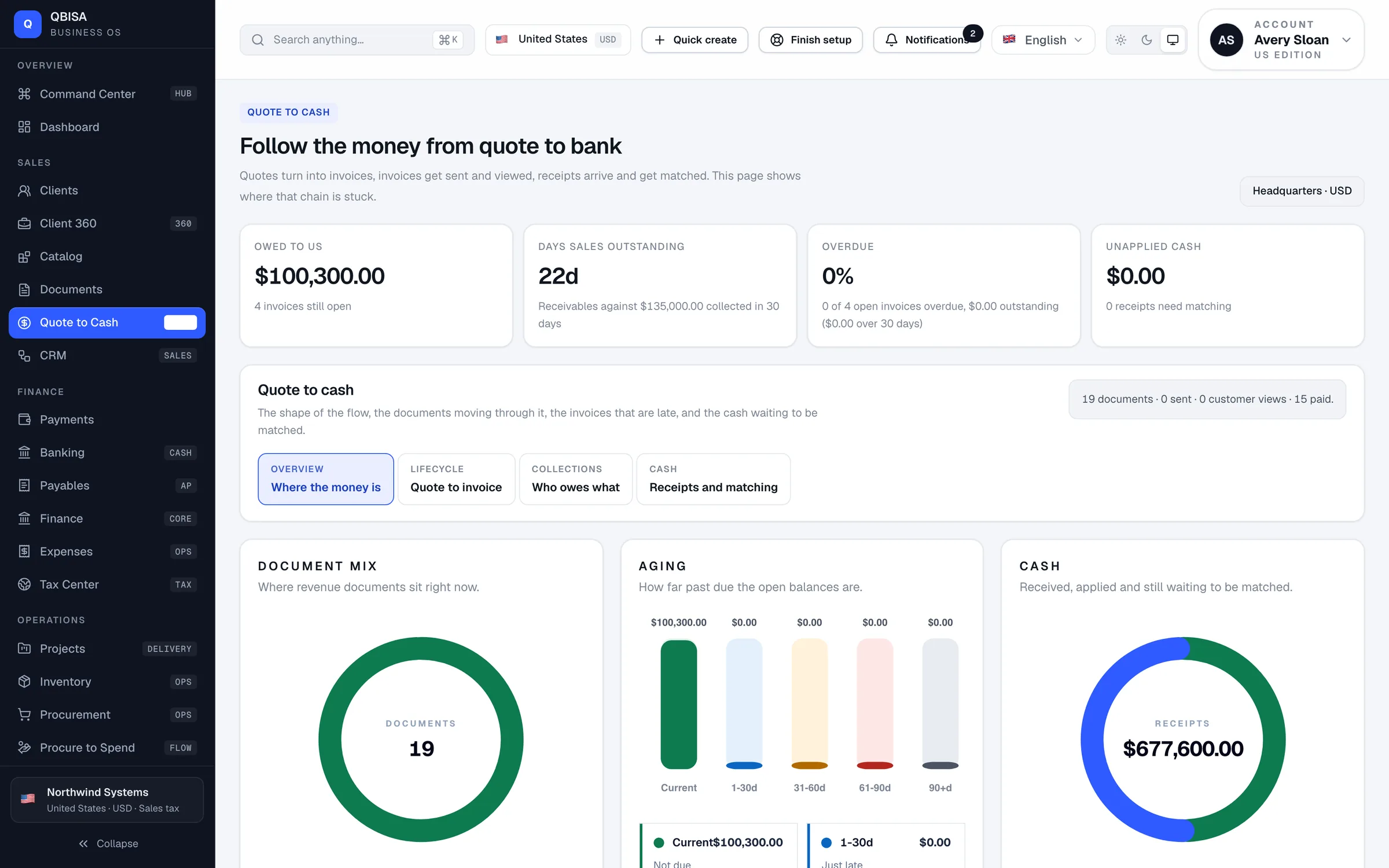
Our own product
QBISA
A next-generation ERP for companies of up to 10,000 employees
Read the case studyWho this is for
Ops teams buried in repetitive work
Remove the manual, error-prone steps eating your team's time so they can focus on judgment calls, not data entry.
Finance & back-office teams
Process documents and data reliably at volume, with AI in the loop where judgment is genuinely needed.
Scaling companies that can't scale headcount
Grow output without growing the team 1:1 — automation built as infrastructure, not a one-off script.
Where teams put it to work

Back-office
Automate repetitive operational work end to end.
Data pipelines
Move and transform data reliably between systems.
Document processing
Extract, classify, and route documents with AI in the loop.

Why this, why now
Every hour your team spends on repetitive work is an hour not spent growing the business.
Automation done right pays for itself in months, not years — and it compounds, because the work it removes never comes back as headcount.
Typical timelines
Ballpark, for a focused first version — not a guarantee, a starting point for scoping.
- Single workflow automation2–4 weeks
- Data pipeline / ETL system4–8 weeks
- AI-assisted document & data processing6–10 weeks
- Multi-system automation suite8–12 weeks
How we build Automation

Find
Identify the high-volume, low-judgment work worth automating.
Pipeline
Build robust data pipelines and system integrations.
Decide
Add rules and AI where human judgment is needed.
Run
Monitoring, retries, and alerting so it runs unattended.
What we ship
- Data pipelines & ETL
- System-to-system integrations
- Document & data processing
- AI-assisted workflows
- Scheduling, retries & alerting
- Monitoring & dashboards
Typical stack
- Python
- TypeScript
- Queues
- Schedulers
- APIs
- LLMs

Questions, answered
High-volume, rule-based, or pattern-based work — and increasingly, judgment tasks with AI in the loop.
Retries, dead-letter handling, and alerting — automation you can trust to run unattended.
We build resilient integrations and monitor them, so changes surface as alerts, not silent failures.

Tell us about your Automation project
Let's turn it into something that earns its place in production.

A specialist reads every message personally — usually within one business day.

Drowning in manual work?
Book a strategy call. We'll discuss your goals, the architecture, and how we'd build it.